From trash to treasure
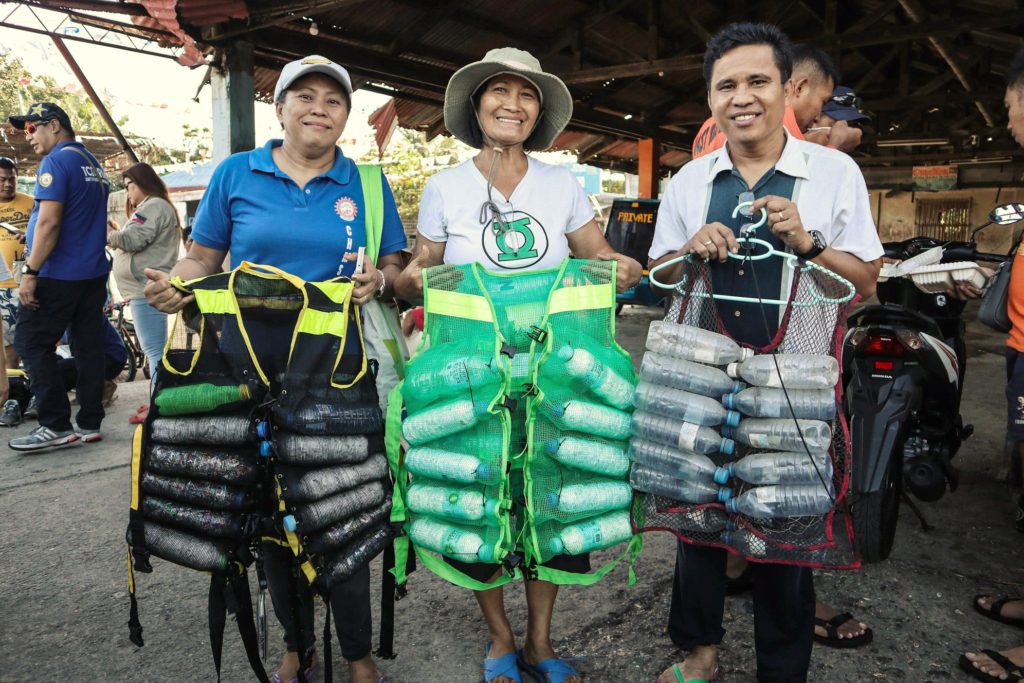
CHMSC is currently working with TUKLAS Innovation Labs to turn potentially harmful plastic bottle trash into low-cost lifesavers. The major beneficiaries of said lifesavers are partners from low income communities who also deserve quality disaster and risk reduction and management measures, such as what is currently being pilot-tested, a lifejacket made from plastic bottles, scrap nets, and other buoyant trash materials. These lifesavers should be very useful in times of flash floods or other water-related calamities.
A Lifeline from Floating Waste
by Rommel Azucena, Jr.
Imagine, it’s a beautiful day, you are sitting in the sand and blissfully watching the calm glistening waves hit the shore. After a while, you saw something shiny floating from a distance. You remembered those romantic books by Nicholas Sparks you read and thought about how there might be a love letter written for you. You stand up and excitedly approach the thing, only to be disheartened that not only there is no neatly rolled piece of love letter but it is a dirty plastic bottle with your name on it.
A plastic bottle takes a thousand years to degrade and broken fishing nets are one of the biggest polluters of the ocean. A 2015 report on plastic pollution by the Ocean Conservancy charity and the McKinsey Centre for Business and Environment ranked the Philippines as the third-largest source of discarded plastic that ends up in the ocean.
Advocates for the protection of environment thought about how this primary source of problem can help benefit the lives of people. Thus, Bottle-Net Life Jacket was born.
A brainchild of Engineer Rey Ramos of the College of Industrial Technology of Carlos Hilado Memorial State College (CHMSC), the Bottle-Net Life Jacket started as a passion to provide cheap and reliable means of safety precaution for the people especially to those living near coastal areas.
The Bottle-Net Life Jacket is a do-it-yourself personal floatation device (PFD) which uses recycled plastic bottles stuffed with plastic wastes and used fish nets gathered during coastal clean-ups. The plastic wastes were first sanitized, cut-up, and used to line the plastic bottles. This will serve as flotation device and protection for the wearer from any impact from collisions or debris. The rest of the jacket is also equipped with survival tools such as waterproof pocket for phones, a whistle, and a flashlight.
This innovation got the attention of TUKLAS Innovations Labs, a community centered organization that supports home-grown solutions that helps community better prepare for disasters. The project was awarded a funding of Php 1-million, with the promise of more, to help the project reach more areas.
Carlos Hilado Memorial State College in collaboration with Tuklas Innovations Labs, adopted the community of Zone 3, Bangga Baybay, Talisay City that benefited 1,911 families. Hesitant at first, the community members were put at ease once they realized that the life-jackets are comfortable, durable, and floats just as good as commercial life jackets.
“A regular life jacket can only keep you afloat for 24 hours, but this will help you stay afloat even for months”, Arlene Visitacion, from the CHMSC Research and Extension Department and the project’s current Community Engagement Officer said.
The project was one of the four (4) finalists selected from all over the world during the Global Innovation Demonstration Day of the Innovation Labs held last May 6 – 9, at London, United Kingdom.
It was during the event that Engr. Ramos found the perfect one-liner to describe his innovative project.
“A lifeline from floating waste”, he said.
Sources:
https://www.scmp.com/lifestyle/health/article/2168819/philippines-plastic-pollution-why-so-much-waste-ends-oceans
https://startnetwork.org/news-and-blogs/lifeline-floating-waste